
Mini-Productivity Hacks
When I was working with multiple teams one of the first workshops I would take them through was about productivity hacks.

When I was working with multiple teams one of the first workshops I would take them through was about productivity hacks. These are techniques, approaches or methods that can be developed into a working habit that improves your productivity – that is, allows you to get more out of your day.
In truth, any aspect of your life can be “hacked” to be more effective and productive including; personal, professional or social.
Irrespective of your position in the organisation; your time is the most valuable asset that you have, both personally and professionally.
Don’t forget that; time is the one thing that money can’t buy!
These tips/hacks can be applied to your life in general, how is going to be dependant on how you live and work but first…
Let’s agree multitasking is bs
The idea that we can efficiently juggle multiple demanding tasks simultaneously is a fallacy. Research overwhelmingly demonstrates that the human brain isn’t wired for true multitasking. Instead, when we appear to be doing multiple things at once, we’re rapidly switching our attention between tasks. This constant task-switching comes at a cost, regardless of gender or a person’s self-proclaimed multitasking ability.
Every time we shift our focus from one task to another, our brains incur a cognitive penalty. This penalty manifests in several ways:
- Reduced Accuracy: We’re more likely to make mistakes or miss important details when switching tasks frequently.
- Slower Completion: Task-switching adds time to completing each task. The constant mental juggling disrupts the focused flow state necessary for peak efficiency.
- Diminished Learning: Multitasking hinders the ability to deeply absorb information and retain new skills.
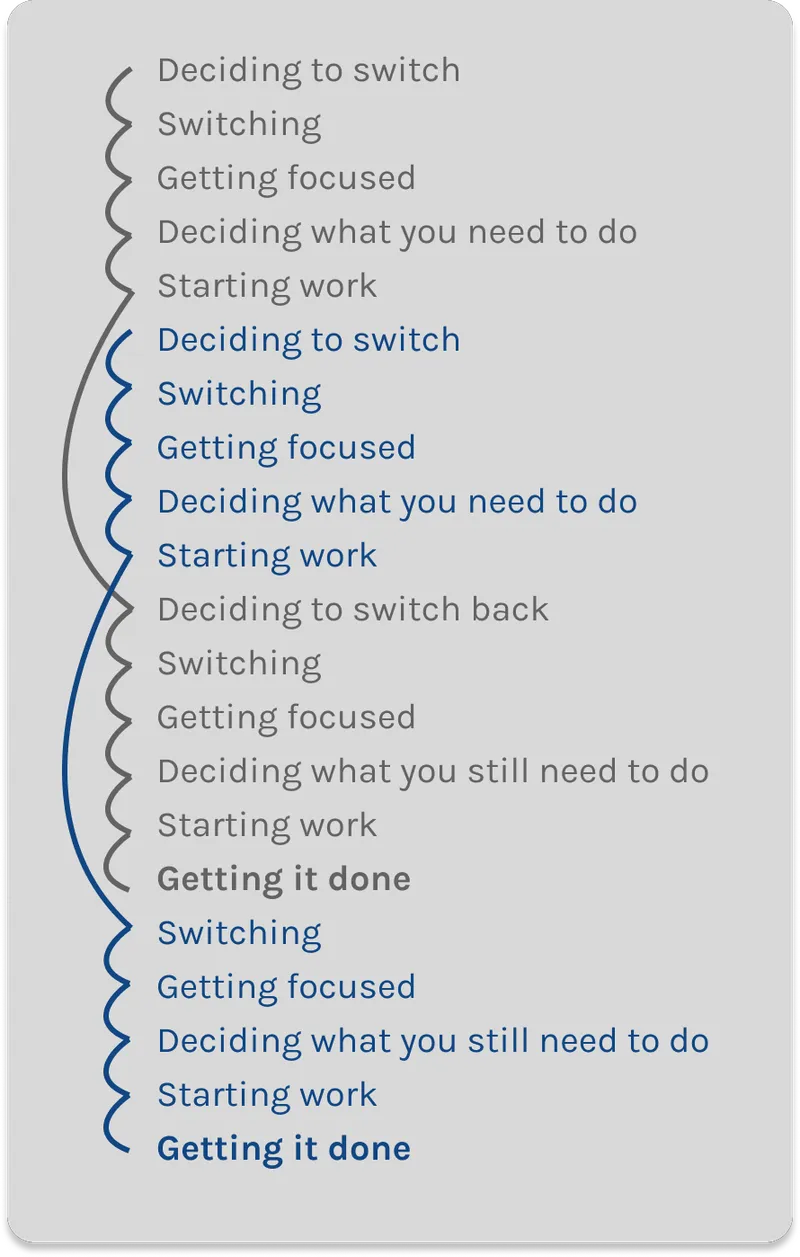
So now that’s out of the way, let’s get started with 4, simple to implement productivity hacks!
# 1 Task Batching
This is the process of reviewing your work regularly and batching tasks that are similar in nature, that being;
- common knowledge or skills required to complete them
- shared resources that are required to assist or work with
Switching between tasks that are different in nature, like analytical vs creative vs administrative, has been shown to have similar “switching costs” than trying to multi-task
#2 Know When to Shut it Down
One of the biggest killers of productivity is hitting the “a wall” and not being effective. Some signs this is happening to you;
- finished reading or writing a passage or email and not remembering what you wrote or read
- eyes glazing over while looking at your screen or work
If this is happening, shut it down, do something creative, active or just fun for 15 minutes and come back refreshed, energised and ready to smash that troublesome task!
#3 Commit to a Daily Top 3 Tasks
Nothing helps productivity than building momentum through the setting and successfully completing tasks that you have committed to.
Every morning review your tasks and commit to completing a TOP 3
#4 If / When / Then statements
The premise of this hack is that our minds work best through the power of association, even subtle ones.
Does “I’m going to lose weight!”, “I’m going to quit smoking” or “I’m going to study” sound familiar?
Evidence from multiple research studies suggests that the issue with these types of goals or statements is that, even considering a persons own drive and motivation levels, success rates are relatively low
The issue comes down to one simple but important, psychological factor;
We rarely associate our goals with a specific event!
Meaning, we have no psychological trigger to remind us of our goals and therefore encourage us to action them
The if / when / then principle has been proven to increase the likelihood of success significantly, in fact in one study, 91% of people who used an if-then statement stuck to an exercise program, versus 39% of non-planners
So IF / WHEN I set personal or professional goals THEN I will use the if/when/then approach
So in summary: To Get Hacking
- Batch your tasks
- When you’re being ineffective – shut it down and refresh
- Commit to your daily top 3 tasks
- Use if/when/then statements for your actions, goals & objectives
What do you think? Let me know!